How the Russian State Feeds Children Military Propaganda
The latest investigations reveal that under the rule of Vladimir Putin the Russian state has stepped up efforts to shape young minds — not with typical schooling, but via a systematic campaign that mixes patriotism, militarisation and propaganda. The aim appears twofold: to indoctrinate children with pro-regime ideology, and to prepare a new generation ready to support or even participate in the state’s war efforts.
From schoolyards to drills — early militarisation
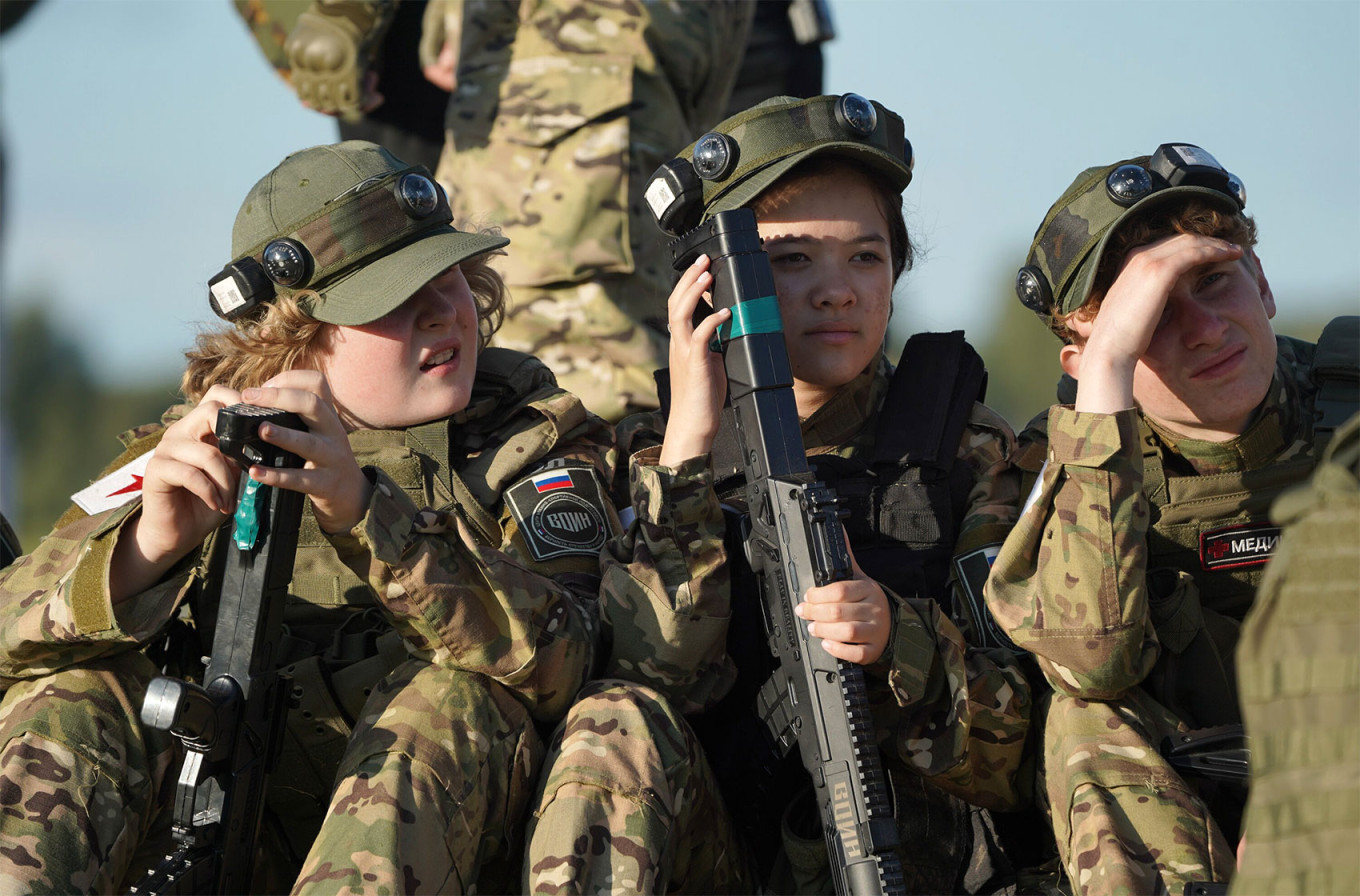
Observers say the slide into militarised upbringing begins early. In Russia, children as young as eight have reportedly been made to attend summer camps where normal holiday activities are replaced by military-style training. According to one recent report, a group of 83 children aged between 8 and 17 took part in a “route march” along the southern River Don — running, crawling across sand and shallow water, wearing camouflage, carrying rifles or toy replicas, and even throwing grenades (whether live or inert remains contested).
What might appear like paramilitary games to outsiders is described by camp organisers as part of a patriotic “youth army” programme — a normal and celebrated part of childhood for some. But critics argue it represents indoctrination: conditioning minors to accept violence, warlike discipline, and unquestioning loyalty to the state.
Indoctrination gets systemic: education, media, and youth organisations
Beyond camps, the Russian regime has expanded school curricula and youth-oriented organisations designed to draw children deeper into state orthodoxy. Groups such as Yunarmia (the “Young Army”), Movement of the First, and variants of “military-patriotic” clubs are increasingly present in Russian schools and occupied territories in Ukraine.
In those settings, children are not just taught patriotic songs or national history. They are drawn into a culture where war, military readiness, and loyalty to the regime are normalised as civic duties. Some are introduced to weapons handling, drone-flying simulators or “survival” exercises.
At the same time, Russian youth media — including video games, social-media apps, and state-controlled entertainment — is reportedly being repurposed to reinforce militaristic messages. What may look like harmless gaming or digital content to many kids often conveys a narrative of conflict, sacrifice, and patriotic duty.
Occupation and assimilation: Ukraine’s children at risk
The problem becomes especially acute in territories of Ukraine occupied by Russian forces. According to Ukrainian investigations, in these regions the Russian administration has systematically replaced Ukrainian educational curricula with Russian ones — and forced local children to take part in patriotic lessons that glorify Russia, its history, and its “special military operation.”
For many Ukrainian children, the change has meant not just ideological pressure but identity erasure. Reports describe enforced attendance at militarised youth clubs, repeated patriotic rituals, and psychological re-education. Some Ukrainian NGOs working to repatriate children from occupied territories describe those children as profoundly changed — docile, trance-like, and ready to obey orders “like little soldiers.”
The scale: a full-blown generational project
According to a recent report, Russia has expanded its network of youth- and children-centred “patriotic-military” organisations to dozens of new centres. As part of a national project, by 2030 the state plans to operate hundreds of such clubs across Russia and occupied territories — turning indoctrination into a systemic, long-term project.
Experts warn this is not just about education or patriotic upbringing: it’s about building a pipeline. The Kremlin appears to be shifting from conscription and mobilisation of adult men, toward early recruitment — normalising martial values, obedience, and war readiness from the youngest ages.
Why It Matters: War, Identity, and the Future
What Russia is building is more than a youth movement or a cultural policy. It’s an attempt to embed militarisation and state loyalty in the very psyche of future generations. For Russians themselves, that could mean a permanent, cyclical war-ready society — where dissent becomes harder, and state narratives dominate early.
For Ukrainians — especially for children forcibly assimilated in occupied territories — the consequences are equally dire: identity erasure, forced loyalty to an occupying regime, and exposure to violence as part of “normal life.” Such forced re-education and militarisation may amount to cultural genocide, argue human-rights experts.
For the world, it serves as a warning: modern war is no longer just fought with missiles or men on a battlefield. It is fought with minds, identities and generations. The propaganda, schooling, media and youth-movements used by states like Russia may shape not just policy — but entire societies.
Conclusion: Childhood as a Battlefield
The evidence is becoming hard to ignore. Under Putin’s Russia, childhood in many regions — especially in occupied zones — is being reshaped into groundwork for war. Through camps, youth movements, schools, media and social pressure, the state is turning children into soldiers, supporters, and silent carriers of a militarised worldview.
Whether viewed as indoctrination, social engineering, or outright brutality, this systematic targeting of children represents a chilling extension of war — one that outlives any single conflict, and aims to craft the future.
Read more:
- Do You Have to Say Manifestations Out Loud? A Friendly Guide to Speaking, Thinking, and Feeling Your Desires
- How Often Should You Manifest? A Practical Law of Attraction Guide
- What Is the Best Time of Day to Manifest? A Practical Law of Attraction Guide
- What Should You Not Do When Manifesting? 15 Mistakes to Avoid
- What Should You Not Say When Manifesting? 21 Phrases to Avoid