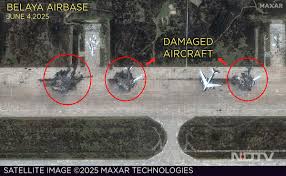
Ukraine Delivers a $250m Blow to Russia
In a highly significant operation, Ukrainian forces struck Belaya Air Base, reportedly destroying one of Russia’s high-value military assets — a blow various intelligence and media assessments now value at roughly US $250 million. The attack has resonated globally, raising questions about Moscow’s ability to project air power and signalling how the conflict’s dynamics continue to shift.
What Happened — The Strike and Its Impact
The strike on Belaya is part of what Ukrainian officials have described as a broader campaign targeting Russian long-range aviation and strategic air capabilities. The operation reportedly destroyed or damaged several aircraft at the base, undermining one of Russia’s few deep-strike arsenals. (Wikipedia)
Some of the aircraft destroyed are believed to be among Russia’s more capable long-range bombers, used to launch high-impact missile– or bomb-based raids — assets that carry considerable value given their strategic role. Analysts assessing the damage estimate the financial cost to Russia at around $250 million, reflecting not just the cost of the planes themselves but also the value of associated infrastructure, munitions and support systems. The strike underscores Ukraine’s growing ability to hit high-value targets deep inside Russian territory.
Why It Matters — Strategic Consequences for Russia and Ukraine
The destruction of such expensive and strategically important aircraft deals a severe blow to Russia — both materially and psychologically. On a material level, it degrades Russia’s ability to carry out long-range strikes, potentially reducing pressure on Ukrainian cities and critical infrastructure far from the front lines.
Psychologically and symbolically, the strike shows that no part of Russia’s military infrastructure — even deep behind the front — is beyond reach. That may force Moscow to reconsider how it deploys its long-range air assets, perhaps limiting their use, dispersing them more often, or shifting reliance to less-capable, more expendable systems.
For Ukraine, the success of this strike is a demonstration of strategic resolve and growing capacity: a message that Kyiv can penetrate deep into Russian territory, even as the war enters its fourth year. It may also bolster morale at home and among allies, reinforcing arguments for continued military support and long-range strike capabilities.
The Bigger Picture — What This Means for the War’s Trajectory
This isn’t an isolated event. The strike on Belaya fits into a broader Ukrainian pattern of targeting Russian military infrastructure, logistics hubs, oil refineries, ammunition factories, and critical production facilities — all intended to degrade Moscow’s war-fighting capacity and sustain pressure on Russia’s economic and industrial backbone. (The Kyiv Independent)
As Russian losses mount — both in manpower and materiel — the balance of power may shift gradually, making it harder for Moscow to sustain large-scale offensives or maintain dominance in the air. If such strikes continue, Russia’s long-term strategic posture could be increasingly constrained, potentially forcing it to adopt more defensive, reactive tactics.
Uncertainties — What We Still Don’t Know
While Ukrainian claims and open-source intelligence point to heavy losses for Russia, exact details remain somewhat unclear. Russia has historically managed to obscure the full extent of its military losses, and verification from independent observers is often limited or delayed. It is also uncertain how many replacement aircraft Russia retains, or how quickly it could rebuild or reconfigure its strategic aviation fleet — especially while engaged in a protracted war and under international sanctions.
Moreover, there is always the possibility of Russian retaliation. Moscow could shift to asymmetric tactics — missile strikes, drone barrages, targeting civilian infrastructure — or refocus its remaining air power on different fronts, potentially increasing danger to Ukrainian civilians or allied assets abroad.
What Comes Next — Eyes on Russia’s Response and Ukraine’s Strategy
In the aftermath of the strike, attention now turns to Moscow’s next moves. Will Russia attempt immediate retaliation? Will it disperse its air assets, further hide them, or withdraw them from deep-strike roles? Or will it accelerate efforts to rebuild its air-power capacity despite logistical and sanction-induced difficulties?
For Ukraine and its supporters in the West, this strike could reinforce the case for supplying advanced strike systems — drones, long-range missiles — to help degrade Russian capabilities further. But it also raises stakes: as Ukraine’s reach increases, there is a risk of the conflict spiralling, or bringing new actors or fronts into play.
In Summary
The strike on Belaya — reportedly inflicting a $250 million hit on Russia’s military — marks one of the biggest individual losses for Moscow in the aerial domain since the war began. It demonstrates Ukraine’s increasing capacity to strike deep, undermines the credibility of Russia’s long-range strike assets, and may shift momentum — at least temporarily — away from Moscow.
But with war still raging, much remains uncertain. The full extent of damage, Russia’s capacity for retaliation, and the long-term strategic implications will become clearer only in the coming weeks and months.
- Can You Manifest at Any Time? How to Align With Your Desire Whenever You Choose
- Can You Manifest Something Impossible? A Practical Law of Attraction Guide
- Can You Manifest the Same Thing Twice? How to Align Without Doubt
- Can You Cancel a Manifestation? How to Redirect Your Energy with Confidence
- Can You Change Your Manifestation? How to Redirect Your Desire with Confidence