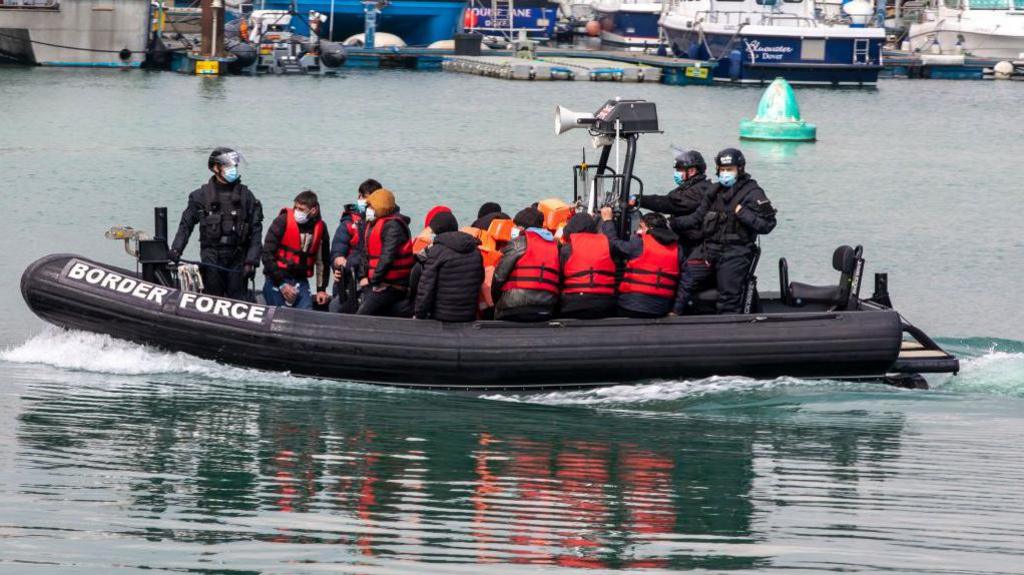
French Maritime Police Agree to Stop Channel Boats… Except if They’re Carrying Migrants
In a significant policy shift, France has announced that its maritime police will begin intercepting small boats in the English Channel — but only if those boats are empty, before migrants have boarded them. The new doctrine, agreed by the French authorities in late November 2025 following pressure from the United Kingdom, marks the most substantial change in cross-Channel migration enforcement in recent years.
The decision comes after mounting frustration in London over the continuous flow of migrants crossing from French shores. According to a confidential document seen by officials and reported by French media, the new intervention framework allows the French maritime gendarmerie to stop “taxi-boats” at sea — those dinghies used by people-smuggling networks — only before they pick up passengers from beaches. Once migrants are aboard, the new powers do not permit interception.
Observers say that limitation severely reduces the practical impact of the policy: smugglers can simply wait for migrants to reach the shore, send them into the water to wade out, board the dinghy, and then head toward UK waters, bypassing the interception mandate.
A Compromise Driven by Pressure — and Significant Risks
The policy change is widely seen as the result of sustained pressure from the UK government. Earlier this month, UK Prime Minister Keir Starmer reportedly wrote to his French counterpart, urging swift action to restore deterrence in the Channel after months of delays.
Under the broader 2025 agreement between the UK and France — the so-called “one-in, one-out” returns deal — migrants arriving illegally via small boats in the UK will be detained and returned to France, while the UK will accept a similar number of people legally from France under controlled and documented routes.
To support the new interception strategy, French police plan to employ tactics such as using nets to disable boat engines — targeting the “taxi-boat” vessels that smugglers use to shuttle migrants across.
But the decision has triggered alarm among human-rights organisations and rescue-at-sea groups. French coastguard and customs unions have warned that intercepting boats at sea — even before migrants board — poses serious risks of drowning or mass casualties, especially if operations go wrong or drivers panic.
One NGO working with refugees warned that the move could push desperate people into even more dangerous routes — using smaller, less seaworthy boats or launching from more remote and riskier locations.
What It Means for UK–France Migration Policy — And Why It May Not Be Enough
This policy shift represents the most concrete action taken so far under the renewed 2025 UK–France cooperation framework aimed at tackling irregular Channel crossings. Yet, the strict limits — no interception once migrants are aboard — draw into question whether it will significantly reduce crossings or just displace risk without ending it.
According to UK border statistics, thousands of migrants continue to attempt the crossing each month in small boats — a trend that has pressured both governments to cooperate more closely.
Supporters of the new policy argue it’s a necessary step — better policing, removal of smugglers’ vessels, and a stronger deterrent signalling that crossings will not be tolerated. UK officials emphasise that this is part of a broader plan combining deterrence at source, legal routes, and returns to dismantle people-smuggling gangs.
Critics say it’s a half-measure that could create a false sense of security. Because intercept powers cease once people board — and because smugglers can easily adapt — the policy may fail to prevent crossings while increasing the dangers for migrants. Furthermore, the legal and moral risks of maritime pushbacks could result in humanitarian disasters.
The Big Picture: Migration, Diplomacy — and Uncertain Outcomes
The decision by France reflects the growing pressure on European governments to tackle irregular migration amid rising numbers and public concern. It also underscores how migration policy is increasingly shaped by bilateral diplomacy — in this case, between the UK and France — rather than regional harmonised EU responses.
Yet as this story evolves, the limits of enforcement become clear. Smugglers are adaptive; migrants are desperate. A policy that only tackles the moment before boarding may do little to prevent crossings — and might simply push migrants toward more dangerous routes or methods, raising the risk of human tragedy.
For now, the Channel remains a high-stakes crossing zone: maritime police patrols, interception nets, diplomatic bargaining — all play a part. But until safe, legal and effective alternatives exist, crossings — and the danger they pose to migrants — may continue.
- Can You Manifest While Sleeping? A Practical Law of Attraction Guide
- Can You Manifest at Any Time? How to Align With Your Desire Whenever You Choose
- Can You Manifest Something Impossible? A Practical Law of Attraction Guide
- Can You Manifest the Same Thing Twice? How to Align Without Doubt
- Can You Cancel a Manifestation? How to Redirect Your Energy with Confidence